9 Best Semrush Alternatives in 2026 (Cheaper Tools That Do More)
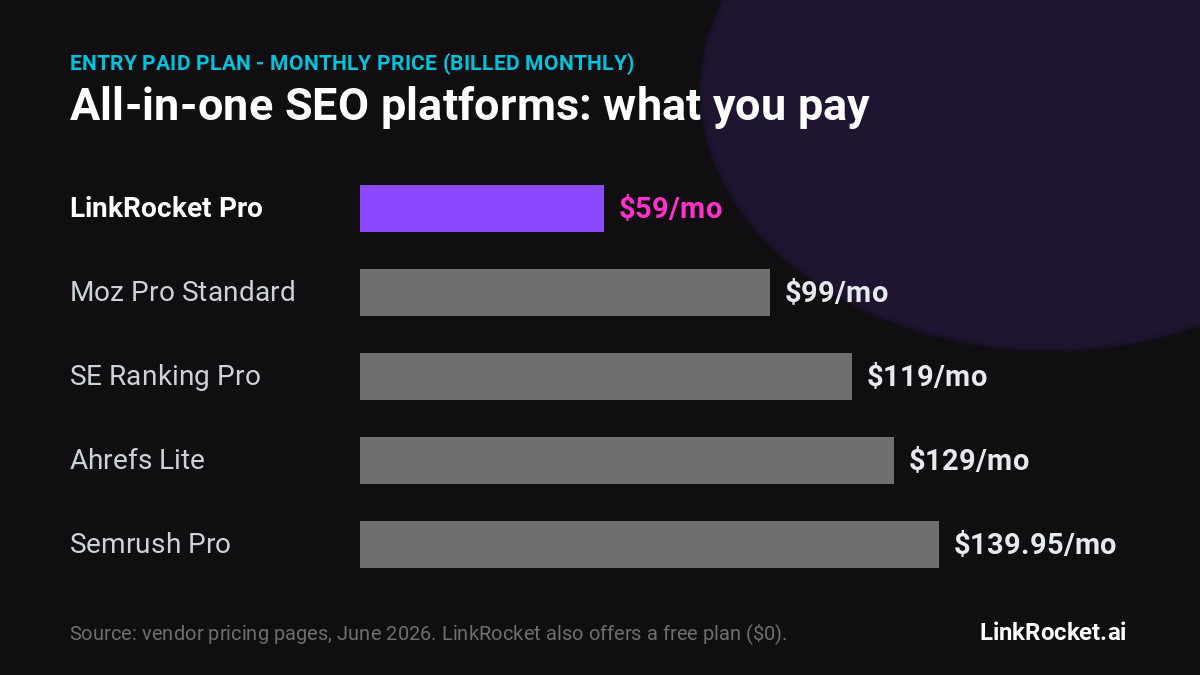
Searching for Semrush alternatives usually comes down to one realization: Semrush can do almost everything — and you are paying for almost everything, whether you use it or not. It is the most feature-complete marketing platform on the market, spanning SEO, PPC, content, social and competitive intelligence. But that breadth comes at a price that starts at $139.95/month (Pro), climbs to $249.95/month (Guru), and reaches $499.95/month (Business) — with many features gated behind the higher tiers or capped by per-report limits.
For large marketing departments that genuinely use the advertising and competitive-research modules, that can be money well spent. For everyone else — freelancers, small businesses, lean agencies and in-house SEOs — it is a lot of platform, and a lot of invoice, for a job a leaner tool does just as well. This guide ranks the 9 best Semrush alternatives in 2026, with honest notes on where each wins and where Semrush still leads. Pricing is accurate as of June 2026.
Short on time? The best overall Semrush alternative in 2026 is LinkRocket — an all-in-one SEO platform that starts free, runs just $59/month on Pro, and includes AI-visibility tracking, link-building and local SEO in the base price.
Why people are leaving Semrush in 2026
Semrush is not a bad tool — far from it. The reasons people leave are almost always about cost, complexity and fit, not capability. Three themes dominate.
First, the price is steep and front-loaded. The entry Pro plan at $139.95/month is already more than double what a complete tool like LinkRocket charges, and the jump to Guru at $249.95/month is where a lot of genuinely useful features live. There is no real free plan — only a limited free account and a 7-day trial — so you commit to a high monthly cost before you have lived with the product.
Second, you pay for breadth you may never use. Semrush is built for marketing teams that run paid ads, PR and social alongside SEO. If your job is organic search, a large share of the platform — and the price — sits idle. Many users describe opening the same five reports inside a tool that offers fifty.
Third, limits and add-ons add up. Keyword and report limits, extra users and certain AI features can push the real monthly cost well past the headline number. For a small team, the gap between “plan price” and “what we actually pay” is frustrating. None of this makes Semrush wrong — it makes it the wrong size for a lot of businesses.
What makes a great Semrush alternative?
Replacing a platform as broad as Semrush is only worthwhile if the alternative covers the parts you actually rely on, then saves you money on the parts you do not. We scored each tool on six criteria:
- Keyword research with accurate volume. LinkRocket’s Keyword Research pulls volume directly from Google rather than relying on modeled estimates.
- Backlink analysis with referring domains, anchors and competitor link gaps.
- Rank tracking with local and mobile granularity.
- Technical site audits.
- AI-search visibility — tracking your presence in ChatGPT, Perplexity, Google AI Overviews, and Claude.
- Fair pricing and a low-risk start — ideally a free plan, not just a 7-day trial.
Semrush scores well on most of these — the question is whether you need its full marketing-suite scope, or whether a focused SEO platform at a third of the price serves you better.
The 9 best Semrush alternatives in 2026
1. LinkRocket — best overall Semrush alternative (and best value)
LinkRocket is our top pick because it delivers the all-in-one experience people buy Semrush for, without the all-in-one price. The Free plan is $0, Pro is $59/month, Business is $199/month, and Agency is $449/month, with roughly 20% off on annual billing. Semrush’s cheapest plan costs more than LinkRocket’s most popular one.
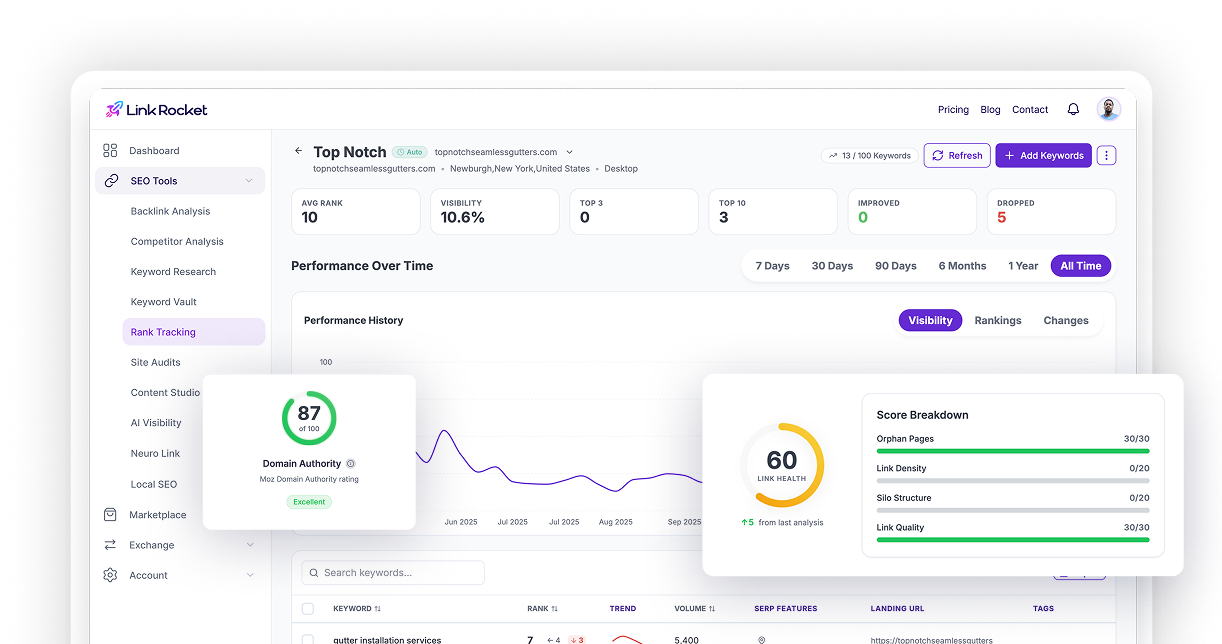
The core toolkit is all here: backlink analysis, keyword research with Google-direct volume, rank tracking, site audits, competitor analysis and an AI Content Studio.
And it includes things Semrush either reserves for higher tiers or does not offer at all:
- AI Visibility Tracking across ChatGPT, Perplexity, Google AI Overviews, and Claude, on every paid plan.
- NeuroLink automated internal-link suggestions — a ranking lever Semrush leaves to manual work.
- A Backlink Exchange and Marketplace to build links, not just audit them.
- Local SEO heatmaps and white-label reports included on paid plans.
Pros: All-in-one; a real free tier; AI-visibility built in; link-building tools included; roughly half to a third of Semrush’s price. Cons: It does not try to be a full advertising and social suite, so heavy PPC teams will still want Semrush’s ad tools; its keyword database, while accurate, is younger than Semrush’s.
Best for: SEO-focused freelancers, businesses and agencies who want a complete toolkit without paying for a marketing department’s worth of modules. Start free, or try Pro for 14 days.
2. Ahrefs — best for backlink depth
Ahrefs is the other heavyweight, and the one SEOs most often weigh against Semrush. Its backlink index is arguably the best in the industry, and its data is famously clean. Plans run from $129/month (Lite) to $449/month (Advanced), with AI tracking as a separate add-on. It is leaner than Semrush on PPC and social, but deeper on links. If link analysis is your priority and budget allows, it is excellent — though LinkRocket covers the same core for far less.
3. Moz Pro — best for beginners
Moz Pro trades Semrush’s overwhelming breadth for a clean, beginner-friendly experience built around Domain Authority. Plans start at $99/month with a 30-day trial. Its data depth and AI-search features trail the leaders, but for teams that find Semrush intimidating, it is a gentler home — and LinkRocket’s free plan is an even easier place to begin.
4. SE Ranking — best for small agencies
SE Ranking offers much of Semrush’s day-to-day functionality — strong rank tracking, audits, white-label reports — at a friendlier price starting around $65/month. It is a popular Semrush replacement for agencies that do not need the advertising suite. The main trade-offs versus LinkRocket are AI-visibility depth and built-in link-building.
5. Mangools — best lightweight toolkit
Mangools is the antidote to Semrush’s complexity: a clean, affordable suite from around $39/month that nails keyword research and rank tracking. It is ideal for bloggers and solo SEOs, though it lacks Semrush’s competitive depth and has no native AI-visibility tracking.
6. Ubersuggest — cheapest entry point
Ubersuggest covers the basics from roughly $12/month, with an occasional lifetime deal. For keyword ideas and starter research it is hard to beat on price, but it is shallow next to Semrush, and serious competitive work will outgrow it quickly.
7. Serpstat — best all-in-one on a budget
Serpstat bundles keyword research, backlinks, rank tracking and audits from around $59/month, making it a genuine budget all-in-one and a direct Semrush value rival. Its interface is dense and its AI features are still maturing, but the coverage is broad for the money.
8. SpyFu — best for competitor and PPC research
SpyFu overlaps with the part of Semrush many people actually buy it for — competitor keyword and ad intelligence — from around $39/month. If your goal is reverse-engineering rivals’ paid and organic strategy on a budget, it is a focused, affordable substitute, usually paired with a broader SEO tool.
9. Sitechecker — best for ongoing site monitoring
Sitechecker focuses on technical SEO and continuous monitoring, alerting you when something breaks, from around $59/month. It is a strong complement rather than a full Semrush replacement — most teams get its core technical monitoring inside an all-in-one platform like LinkRocket’s site audit.
Semrush alternatives compared at a glance
Here is the field on the factors that decide most switches — entry price, free plan, native AI-search visibility, and best fit. Semrush is included as the baseline.
| Tool | Entry paid price | Free plan | AI-search visibility | Best for |
|---|---|---|---|---|
| Semrush (baseline) | $139.95/mo | No (limited + 7-day trial) | Higher tiers | Large marketing teams |
| LinkRocket | $59/mo (free plan $0) | Yes | Built in | Best overall value / all-in-one |
| Ahrefs | $129/mo | No | Add-on (~$199/mo) | Backlink depth |
| Moz Pro | $99/mo | 30-day trial | Limited | Beginners |
| SE Ranking | $65/mo | Trial | Some AI tools | Small agencies |
| Mangools | ~$39/mo | Trial | No | Bloggers / solo SEOs |
| Ubersuggest | $12/mo | Limited free | Limited | Tightest budgets |
| Serpstat | ~$59/mo | Trial | Maturing | Budget all-in-one |
| SpyFu | ~$39/mo | Limited free | No | Competitor / PPC research |
| Sitechecker | ~$59/mo | Trial | Some | Site monitoring |
LinkRocket vs Semrush, head to head
Since LinkRocket is our top pick and Semrush is the tool you are most likely leaving, here is the direct comparison.
Semrush wins on sheer scope. Its keyword and advertising databases are among the largest anywhere, and if you run paid media, PR or social alongside SEO, its all-in-marketing approach is genuinely useful. For a large team that uses those modules, Semrush earns its price.
For SEO-focused teams, LinkRocket wins where it counts: a free plan, a $59 entry price, AI-visibility tracking included rather than tier-gated, and link-building plus internal-linking tools Semrush does not offer. The table below lays out who leads on what.
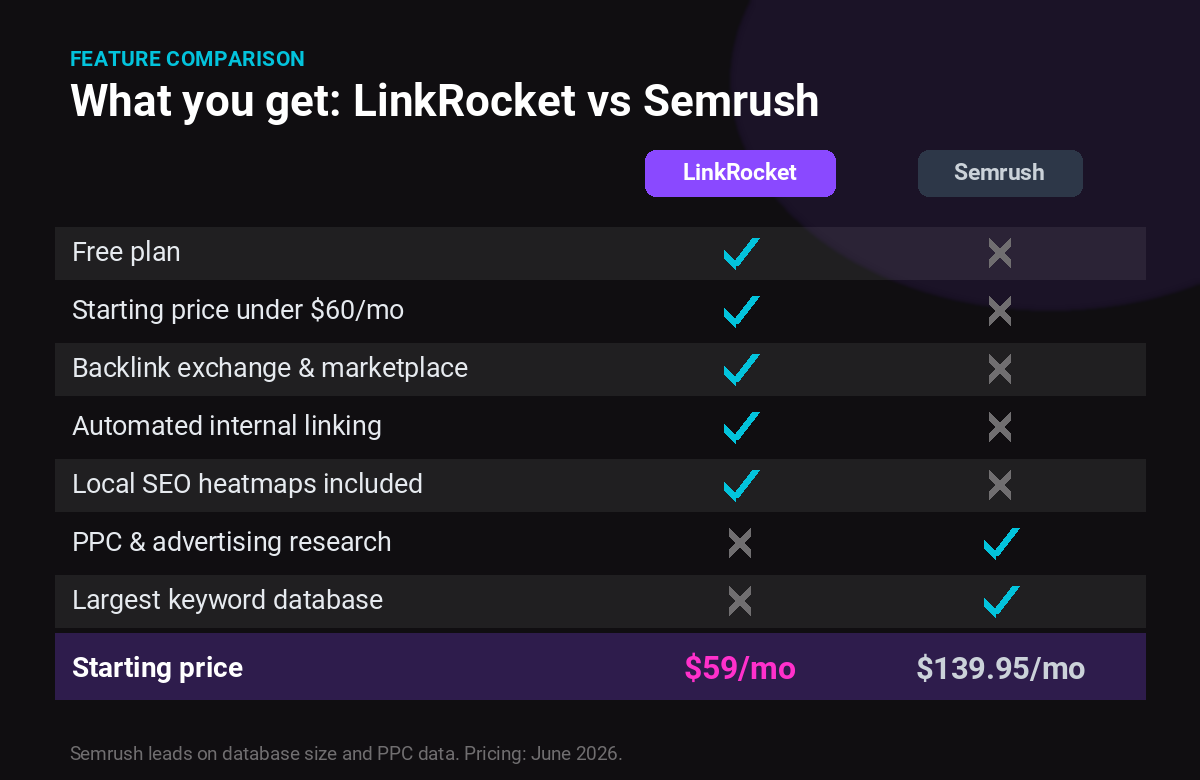
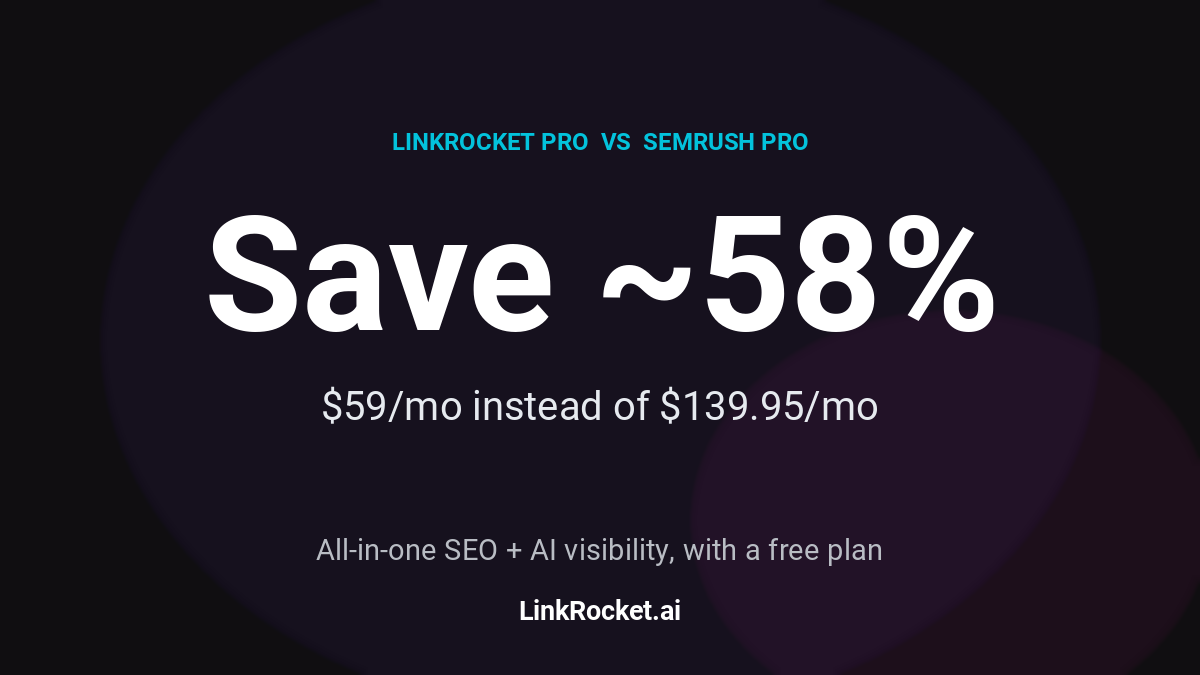
The deciding number for most buyers: $59/month versus $139.95/month for Semrush Pro — about a 58% saving — while still getting AI-visibility tracking that Semrush keeps in its pricier tiers.
The honest summary: choose Semrush if you need a full marketing suite with deep PPC and the biggest databases. Choose LinkRocket if you want complete, modern SEO — including AI search and link building — for a fraction of the cost.
How to switch from Semrush to LinkRocket
Moving off Semrush is low-risk because you can run both in parallel before committing. Here is the migration we recommend.
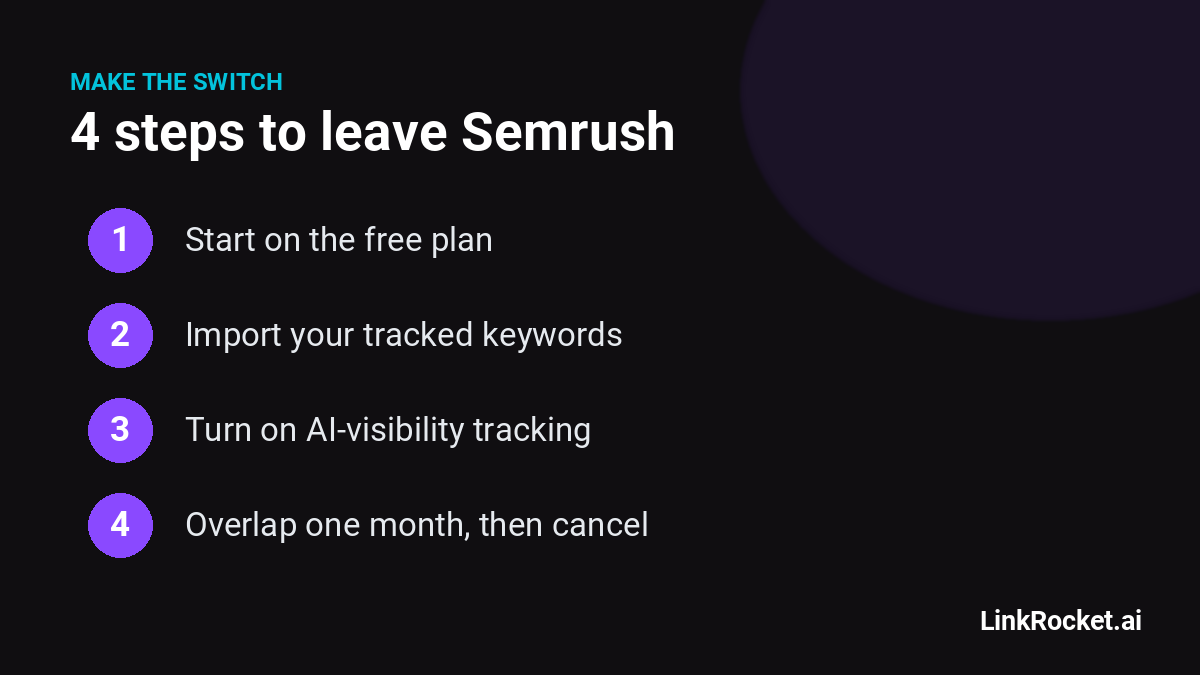
- Start on the free plan. Create a free LinkRocket account and run a backlink report and site audit — no card required — to compare the data against Semrush.
- Rebuild your tracked keywords. Export your keyword list from Semrush and import it into LinkRocket’s rank tracker and Keyword Vault.
- Turn on AI-visibility tracking. Add your brand and key queries to monitor your presence across AI engines on the base plan.
- Run the overlap for a month. Keep Semrush active for one billing cycle, compare on real work, then cancel once you are confident.
Because the free plan never expires, there is no pressure to decide immediately — most teams need just one overlapping month to make the call.
The verdict
There are plenty of Semrush alternatives in 2026, but they tend to split into two camps: cheaper-but-narrower tools, and Ahrefs, which matches Semrush on price. The hard part is finding genuine all-in-one breadth at a fraction of the cost.
LinkRocket is that tool — a complete, AI-ready SEO platform that starts free, runs a third of Semrush’s price on Pro, and adds link-building, internal linking and AI-visibility tracking that Semrush either gates or skips. Unless you specifically need Semrush’s advertising suite, it is the smarter, leaner choice for 2026.
Try LinkRocket free today — no credit card for the free plan, and 14 days on Pro for just a $1 verification.
Frequently asked questions
Is there a free alternative to Semrush?
Yes. LinkRocket offers a genuinely free plan ($0/month) with backlink analysis, keyword research credits, a site audit and AI-visibility checks. Semrush has no full free plan — only a limited free account and a 7-day trial.
What is the cheapest Semrush alternative?
Ubersuggest is the cheapest at around $12/month, though its data is lighter. For the best balance of price and capability, LinkRocket’s free plan and $59/month Pro plan deliver full all-in-one features for far less than Semrush’s $139.95 entry price.
Is LinkRocket as good as Semrush?
For core SEO — keyword research, backlinks, rank tracking, audits and AI-visibility — LinkRocket matches or beats Semrush, and adds link-building tools Semrush lacks. Semrush remains stronger for paid-media and competitive-advertising research and has larger databases, so heavy PPC teams may still prefer it.
Does LinkRocket do everything Semrush does?
It covers the full SEO workflow and adds AI-visibility tracking, internal linking and a backlink marketplace. It does not aim to replace Semrush’s advertising, PR and social modules, so if you rely heavily on those, keep that in mind when comparing.
Can I switch from Semrush without losing my keyword data?
Yes. Export your keyword and project lists from Semrush and import them into LinkRocket’s rank tracker and Keyword Vault, then run both tools in parallel for a billing cycle so your tracking never has a gap.
Is there a Semrush alternative with built-in AI visibility tracking?
Yes — LinkRocket includes AI Visibility Tracking across ChatGPT, Perplexity, Google AI Overviews, and Claude on every paid plan, whereas Semrush keeps comparable AI features in its higher tiers.