AI Visibility Tracking: How to Monitor Your Brand in ChatGPT, Perplexity & Claude
Someone asks ChatGPT for the best tool in your category. It names three. You’re not one of them. That customer is gone — and you never even knew they were shopping.
This happens now. Constantly. And your analytics can’t see a second of it. More and more people get their answer straight from ChatGPT, Perplexity, or Google’s AI Overviews and never click through to anyone. No click, no visit, no trace in your reports. AI visibility tracking exists to close that blind spot.
What is AI visibility tracking?
AI visibility tracking — or LLM visibility tracking — measures how often the models mention your brand, and how kindly. Not where you rank on a page of blue links. Whether ChatGPT, Perplexity, Claude, and AI Overviews bring you up when someone asks a question you ought to own.
It comes down to three things. Are you mentioned for the prompts that matter? How are you described — recommended, or waved off? And are you cited with a link? Track those over time and you’ll know whether you’re gaining or losing ground in the place discovery is quietly moving to.
Why your usual tools miss it
Rank tracking checks a fixed spot. Keyword X, position 4. Simple.
AI answers don’t sit still. Ask the same question twice and the wording shifts. Ask from two accounts and the brands named change. There’s no steady “position 4” to write down — every answer is generated fresh and tuned to the person asking.
Then there’s the traffic problem. Most AI answers end without a click. You could be recommended by ChatGPT ten thousand times a month and see nothing in Google Analytics. Nothing at all. To measure this you have to ask the models directly and read what they say back. A rank report won’t show it. Neither will a traffic dashboard.
How the tracking works
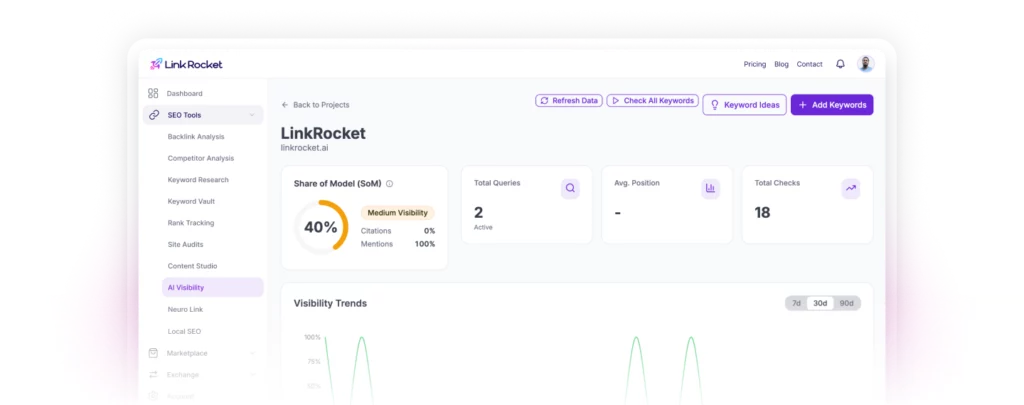
The dashboards differ. The mechanics don’t:
- Pick your prompts. The real questions a buyer would type — “best backlink analysis tool,” “affordable Ahrefs alternative,” “how do I check competitor backlinks.”
- Ask the models on a schedule. The tool fires those prompts at ChatGPT, Perplexity, Claude and others on a regular beat, saving every answer.
- Find the mentions. It scans each reply for your name, notes whether you were cited with a link, and logs which competitors turned up beside you.
- Grade it. A grudging mention isn’t a recommendation. Good tools score the tone and work out your share of voice against rivals.
- Watch the trend. One query is noise. The pattern over dozens of runs is the signal.
What’s worth watching
- Mention rate — how often you’re named at all. The foundation.
- Share of voice — you versus competitors on the same prompts.
- Sentiment — recommended, mentioned in passing, or warned against.
- Citations — whether the model links to you, which can actually send traffic.
- Model coverage — you might own Perplexity and be invisible in ChatGPT. Track them apart.
How to get mentioned more
Tracking is the diagnosis. Here’s the treatment. It rhymes with good SEO, but leans toward how models pick their sources.
Get talked about on trusted sites. Models lean hard on what other reputable sites say about you. Being referenced across respected pages in your niche matters as much as your own homepage does — arguably more. This is exactly where a strong backlink profile feeds straight into AI visibility. The same links that help you rank help you get cited.
Answer the actual questions. Clear pages that directly answer real prompts are easy for a model to quote. Vague ones get skipped.
Show up where the models look. Reviews. Comparison posts. Industry roundups. Community threads. These feed AI answers in a way your marketing copy never will.
Keep your story straight. Describe what you do the same way everywhere. Consistency makes you easy to represent — and hard to get wrong.
What AI engines actually weigh
The four habits above are the behaviors. Underneath them sits a more mechanical question: when a model decides whether to quote your page, what is it actually grading? It helps to think in categories, because that is how the tools built for this — LinkRocket’s GEO Audit among them — score a page. Six of them, roughly in order of how much they move the needle.
- AI citability — the heaviest factor by far. Can a model lift a clean, self-contained answer straight off your page? Clear statements, tight paragraphs, real numbers, and a parseable structure all feed it. Vague, meandering copy doesn’t get quoted.
- E-E-A-T signals — author bios, credentials, citations to sources models already trust. AI leans on the same experience-and-authority cues Google does when it decides who is worth citing.
- Brand signals — how clearly you exist as a distinct entity. Consistent naming, a knowledge-panel presence, an unambiguous description of what you do. A model cannot attribute a fact to a brand it cannot pin down.
- Technical foundation — whether the AI crawlers can even reach you: GPTBot, Google-Extended, and ClaudeBot unblocked, a cooperative robots.txt, and increasingly an llms.txt file. Fast, secure, and mobile-friendly still count too.
- Schema markup — JSON-LD that tells a model what your content is, not just what it says. Structured data removes guesswork.
- Platform quirks — ChatGPT, Perplexity, Google’s AI Overviews, and Claude don’t surface sources identically, so the last slice is tuning for whichever ones your audience actually uses.
You don’t have to grade yourself by hand. A GEO Audit scores a page across all six, weights them, and hands back a prioritized fix list — the optimization companion to the tracking above. The tracker tells you where you stand; the audit tells you what to change.
The bottom line
AI search is already deciding who gets recommended — quietly, and without sending you a report about it. You can track that, or you can keep flying blind.
The work itself isn’t exotic. Show up on trusted sites, answer the questions people actually ask, and keep your story consistent. The brands the models name aren’t lucky. They’re just the ones who made themselves easy to cite.
Frequently asked questions
What is LLM visibility tracking?
LLM visibility tracking is the practice of monitoring how often and how favorably large language models such as ChatGPT, Perplexity, and Claude mention your brand in their answers. It measures whether AI assistants surface you for relevant questions, rather than where you rank in traditional search results.
How do I track my visibility in ChatGPT?
Use an AI visibility tool that queries ChatGPT with the prompts your customers would ask, on a schedule, and records whether your brand is mentioned, how it’s described, and which competitors appear alongside you. Because AI answers vary between runs, the meaningful signal is the trend across many queries, not any single response.
Why can’t Google Analytics show my AI visibility?
Most AI answers don’t generate a click, so no visit reaches your site and nothing appears in your analytics. You can be recommended frequently by an AI assistant with zero trace in traffic reports. Measuring it requires querying the models directly and analyzing their responses.
Is AI visibility tracking different from rank tracking?
Yes. Rank tracking records a fixed position for a keyword in search results. AI answers are generated fresh each time and personalized, so there’s no stable position to record — tracking instead measures mention rate, sentiment, and share of voice across repeated queries to the models.
How can I improve how often AI models mention my brand?
Earn mentions and citations on trusted third-party sites, publish content that directly answers the questions buyers ask, make sure you’re present in the reviews and comparison articles models draw from, and keep your brand described consistently across the web. A strong backlink profile supports all of this.
Does AI visibility tracking help my regular SEO?
They are measured separately — one watches AI answers, the other watches Google’s results — but they pull in the same direction. The work that gets you cited by AI (authoritative content, quality backlinks, a consistent brand, clean structure) is largely the same work that lifts traditional rankings, so improving one usually nudges the other.
How long before AI visibility improves?
Expect gradual movement, not an overnight jump. AI models refresh their sources on their own cadence, so it is normal to watch 30-to-90-day trends rather than any single check. New mentions and citations on trusted sites are what move it, and those take time to accumulate.
Start seeing what the models say
You can’t fix a blind spot you can’t see. Track your visibility across ChatGPT, Perplexity, and Claude with LinkRocket, then use what you learn — and your link-building tools — to catch the competitors the models keep naming instead of you.