How to Do a Competitor Backlink Analysis (Step-by-Step Guide)
The slowest way to build links is to sit and brainstorm where you might get them. The fastest way is to steal the answer.
Not the links themselves — the list. Your competitors already talked dozens of sites into linking to them. Every one of those sites has proven it’ll link to a business like yours. Competitor backlink analysis is just finding that list and working down it. You start from warm prospects instead of a blank page.
What it actually is
Competitor backlink analysis means pulling the backlink profiles of the sites beating you in search, then working out which of their links you could realistically earn too. Three questions, really. Who links to them? Why? And which of those doors will open for you?
It’s the sequel to auditing your own profile. Know your own links first — our backlink analysis guide covers that — and this step turns “we should build links” into a ranked list of names to contact.
Step 1: Pick the right competitors
Your search competitors aren’t always your business competitors. The site outranking you might be a niche blog, a review site, or an affiliate — not the shop down the road. So don’t guess. Look at who actually holds page one for the keywords you want, and pick from there.
Choose three to five. Include a couple your own size, because those are the realistic targets. Throw in one giant for perspective if you like. But analyze a site fifty times your authority on its own and you’ll just build a wish list you can’t act on.
Step 2: Pull their profiles
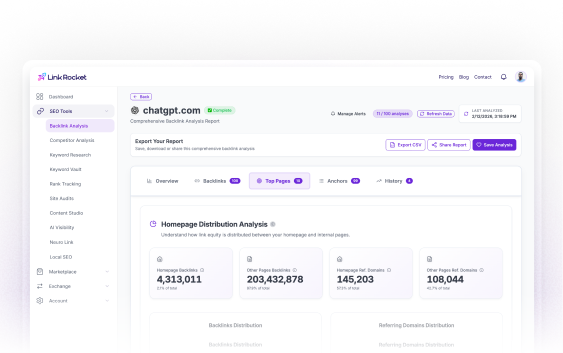
Feed each competitor’s domain into a backlink tool — LinkRocket, Ahrefs, SEMrush, Moz, Majestic, any of them work — and export the referring domains. You want each linking site, its authority score, the page it points to, and the anchor text. Do it for every competitor on your list. Side by side is where the patterns show up.
Watch referring domains, not raw link counts. A rival with 400 links from 300 domains is worth studying. One with 4,000 links from 50 domains is mostly noise.
Step 3: Run the gap analysis (this is the good part)
Here’s where the payoff lives. A backlink gap analysis — sometimes called a link intersect — lines up two or more profiles and shows the domains linking to your competitors but not to you. Most tools have a button for it; in LinkRocket that button is the Link Gap Analysis inside Competitor Analysis, which lines up as many as ten domains at once. Enter your domain plus two or three rivals. Out comes the list.
That list is the whole point. Every site on it has already linked to someone like you. It’s not a cold pile of maybes. It’s a warm list of proven, willing linkers — ranked by opportunity the moment you sort it by authority and relevance.
Step 4: Work out why each link exists
A domain on your gap list is a lead, not a gift. Before you reach out, learn why the link is there. That tells you how to earn your own version.
Most of them fall into a few buckets:
- Guest post — they wrote for the site. You can pitch one too.
- Resource or listicle — qualify, then ask to be added.
- Editorial mention — earned with PR, data, or something genuinely worth citing. Hardest to copy. Most valuable.
- Directory or profile — usually easy, usually low value.
- Digital PR — tied to a campaign. File it under inspiration.
Group your prospects by type and outreach gets far easier. Pitch all the guest-post targets in one batch, all the resource pages in another. Beats bouncing between unrelated sites one at a time.
Step 5: Prioritize, then move
You can’t chase everything. So rank it. Score each prospect on authority, relevance, and how gettable the link looks — and give relevance real weight, because a smaller site in your niche often beats a bigger one outside it.
One shortcut pays off every time: watch for domains that appear across several competitors. If three rivals all have a link from the same industry blog, that blog clearly links to businesses like yours. Put it at the top.
After that it’s execution. Outreach works. So does the Backlink Exchange or Publisher Marketplace when you want to close gaps faster than cold email allows.
How often should you do this?
A deep dive once a quarter is plenty. Link profiles don’t transform overnight. What’s worth doing more often is monitoring — catching a competitor’s new links while the opening is still fresh. Most tools will alert you. That turns a quarterly project into a steady drip of leads.
Where people go wrong
- Picking the wrong competitors. Analyze who ranks for your keywords, not just your business rivals.
- Copying links blindly. Some are toxic, paid, or irrelevant. Vet before you chase.
- Studying one competitor. The domains linking to several rivals are the strongest signal. You only see them by comparing.
- Sorting by authority alone. Relevance matters just as much. Don’t let it drop off the list.
- Doing it once. They keep earning links. Analyze quarterly, monitor in between.
The takeaway
Competitor backlink analysis isn’t about copying a rival link for link. It’s about reading the pattern — who links to the people winning your keywords, and which of those you can win too.
Pick the right competitors, run the gap analysis, sort by opportunity, and you’re left with something most link building never produces: a short, ranked list of sites that have already proven they’ll link to a business like yours. The rest is follow-through.
Frequently asked questions
What is competitor backlink analysis?
Competitor backlink analysis is the process of examining the backlink profiles of sites that outrank you to see where their links come from and which of those sources you could earn too. It turns link building from guesswork into a prioritized list of proven, reachable prospects.
How do I find my competitors’ backlinks?
Enter a competitor’s domain into a backlink tool such as LinkRocket, Ahrefs, SEMrush, Moz, or Majestic, then export its referring domains along with authority scores, target pages, and anchor text. Repeat for each competitor so you can compare profiles and spot shared linking sites.
What is a backlink gap analysis?
A backlink gap analysis (or link intersect) compares your profile against two or more competitors and returns the domains that link to them but not to you. Because every site on that list already links to sites like yours, it functions as a ready-made, high-probability prospect list.
Can I check competitor backlinks for free?
Yes, free tools and free tiers — including LinkRocket’s — let you see a portion of a competitor’s referring domains. Free tools usually cap the number of links shown and refresh slowly, so they’re good for a first look before moving to a paid tool for a full gap analysis.
How often should I analyze competitor backlinks?
A thorough analysis each quarter suits most sites, supplemented by ongoing monitoring for competitors’ new links so you can act on fresh opportunities quickly.
Turn the gaps into links
A competitor analysis is only worth the effort if you close what it finds. Got your prospect list? Run your competitor analysis in LinkRocket, then use the Backlink Exchange and Publisher Marketplace to start earning the links your competitors already have.