Why AI Models Cite Some Content and Ignore Yours
You ask ChatGPT for the best tool in your category. It answers in a confident paragraph and names three sources. You scroll. Yours isn’t one of them. So you open the pages it did cite, expecting to feel outclassed, and instead you find posts that are shorter, plainer, and honestly not written as well as yours.
That gap is the whole story. Being good is not the same as being citable, and AI models are ruthless about the difference. They aren’t reading your content the way a person does. They’re scanning it for a clean, liftable answer they can attribute to a source they already trust.

A citation is a shortlist, not a coin flip
Here’s what happens under the hood when a model answers a question. It pulls a pool of candidate pages, reads them fast, and picks a handful to synthesize into one response. The pages that make that final cut share a trait that has nothing to do with prose: they say the thing early, plainly, and in a shape the model can extract without guessing.
Position is a huge part of it. Analyses of thousands of AI answers keep finding the same pattern — a large share of what ChatGPT cites comes from the first third of a page. Not the conclusion, not the section you saved for readers who scrolled. The top. If your actual answer sits below a warm-up introduction, you have functionally hidden it from the model.
This is why product and documentation pages punch above their weight. One widely-cited study found product content makes up around 70% of citations in some contexts — not because it’s inspiring, but because it’s specific and structured. Meanwhile the “10 ways to live your best life” essay, however lovely, gives a model nothing crisp to quote.
What AI rewards vs. what old SEO optimized for
A lot of teams are still writing for a 2019 algorithm and wondering why the citations aren’t coming. The incentives quietly flipped. It helps to see the two side by side.
| What legacy SEO chased | What AI models actually reward |
|---|---|
| Keyword density and exact-match phrasing | A direct, self-contained answer to the real question |
| Long intros that “warm up” before the point | The point in the first paragraph or two |
| Clever meta descriptions | Structured data and schema the model can parse |
| Word count for its own sake | Depth, specificity, and quotable facts or stats |
| Anonymous, brand-agnostic “content” | A recognizable brand entity with authority signals |
None of this means writing is dead. It means the model needs a reason to trust you and a sentence it can lift. If your page has both, prose quality becomes the tiebreaker — which is exactly where you want the fight to happen.
Structure the page like an answer, not an essay
The single most controllable lever here is shape. Lead each section with the answer, then support it. Turn your H2s into the questions people actually ask, because those headings are often what a model matches against. Write self-contained paragraphs that make sense even when pulled out of context, since that is precisely how they’ll be used.
Facts help more than adjectives. “Faster” is forgettable; “cut audit time from three hours to twenty minutes” is a sentence a model can quote and attribute. Add schema so the machine reading your page isn’t left inferring what’s an author, a rating, or a step. LinkRocket’s Site Audit and its GEO scoring both flag pages that are missing this kind of structure, and the fix is usually mechanical rather than creative.
Brand mentions are the quiet decider
Ask a model to recommend something and watch what it reaches for: names it has seen, in context, again and again. That recognition is built off-page. Every time your brand is discussed on a review site, an industry publication, a forum thread, or a Reddit answer, you become a slightly more defined entity in the model’s picture of your niche.
The uncomfortable implication is that you can’t fully write your way to AI visibility from your own blog. You need other people talking about you, consistently, using the same brand name and description everywhere. Consistent naming, a real presence on the sites your buyers already trust, and the occasional piece of original data that others cite — those are what turn a domain into a source a model is comfortable naming out loud.
Backlinks didn’t die, they changed jobs
For a while the internet debated whether links still mattered in an AI-answer world. They do, just differently. A link used to be a vote that nudged you up a ranking. Now it doubles as a trust signal that helps a model choose between three pages that all answer the question equally well. Faced with a tie, it leans toward the source other credible sites vouch for.
So the old work still pays off, in an unexpected currency. Understanding which links your competitors earn — and which content those links point at — tells you which formats get cited in your space. A backlink analysis and a proper competitor backlink audit are less about copying links now and more about reverse-engineering what AI already trusts.
Freshness and the end of the click chase
Two more forces are worth naming. The first is recency: models lean toward recently updated information, especially on fast-moving topics, so the evergreen post you published in 2021 and never touched is quietly aging out of consideration. A dated refresh with new figures often does more for citability than a brand-new article — and it’s a fraction of the work.
The second is a shift in what you’re even chasing. For twenty years the goal was the click: win the ranking, earn the visit. In an answer engine a citation can do its job without sending a single visit, by planting your brand and your claim inside the response the user reads. If you only count sessions, that looks like a loss. It isn’t. Being named as the source a buyer reads compounds — the more often you’re cited, the more the model treats you as a default, and the harder you are to dislodge.
Stop guessing which pages AI trusts
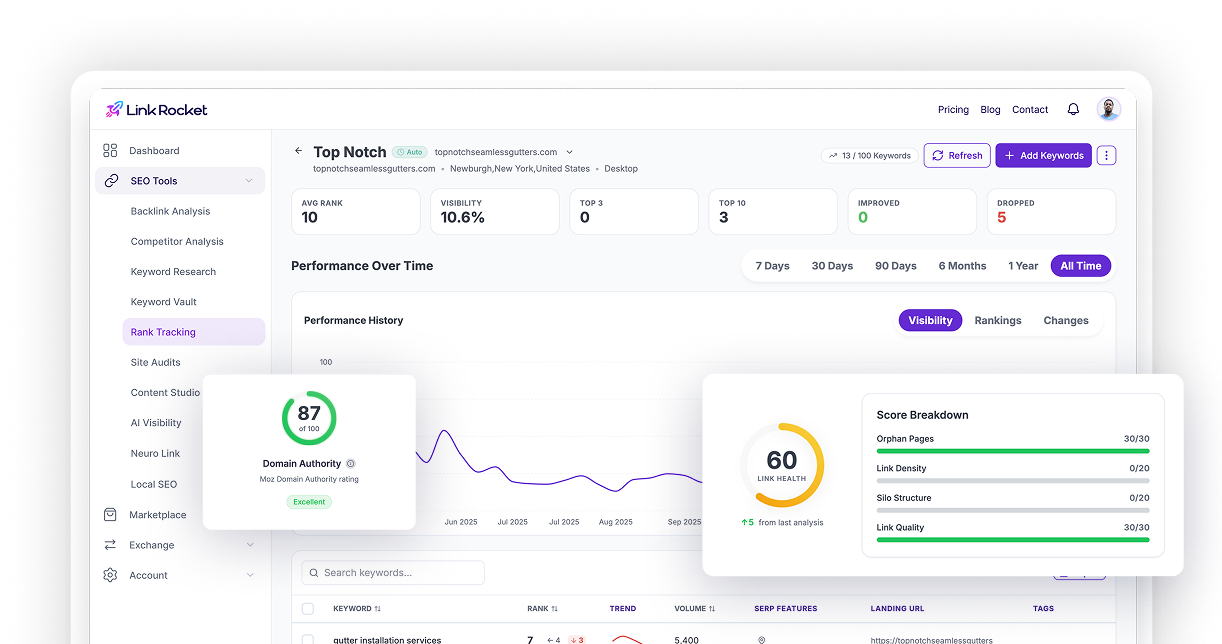
You can do everything above and still be flying blind, because none of it tells you whether it’s working. The only way to know if a model cites you is to ask the model, repeatedly, and watch. That’s the gap LinkRocket’s AI Visibility fills: it submits your target questions to ChatGPT, Perplexity, Google AI Overviews, and Claude on a schedule, records whether your brand or domain shows up, captures the sources each answer cited, and reports a mention rate you can actually trend over time. When a competitor gets named and you don’t, you see the exact query and the exact page that beat you.
Pair that with a generative engine optimization mindset and LinkRocket’s GEO Audit, which scores a page across six weighted categories — AI Citability carries the most weight, followed by E-E-A-T and brand signals — and hands you a prioritized list of what to fix. Between the two, you stop guessing why some content gets cited and yours gets ignored, and start closing the gap deliberately, one page and one query at a time.
Frequently asked questions
How do AI models decide which content to cite?
An AI model retrieves a pool of candidate pages, then picks a small shortlist that best answers the prompt. It favors content that states a clear, self-contained answer near the top, is structured with headings and schema, comes from a recognizable brand, and is backed by authoritative links. Writing quality alone does not decide it; extractability and authority do.
Why does Perplexity or ChatGPT rank some content higher than mine?
Usually because the cited page answers the question in the first third of the content, uses clean structure the model can lift, and comes from a domain the model already treats as trustworthy. If your answer is buried below an introduction, or your brand is not recognized as an entity, a thinner but better-structured page will win the citation.
Do backlinks still matter for AI citations?
Yes, but the job changed. Backlinks no longer just move you up a list of blue links. They act as an authority signal that helps AI models decide which of several similar pages to trust and quote. Links from relevant, credible sites make your content a safer source for a model to cite.
What are brand mentions and why do they affect AI visibility?
Brand mentions are the times your brand is named across the web, including on review sites, forums, Reddit, and industry publications, whether or not they link to you. Frequent, consistent mentions help AI models recognize your brand as a distinct entity, which makes them more likely to name and cite you in answers.
How can I track whether AI models are citing my content?
Use an AI visibility tool that submits your target questions to models like ChatGPT, Perplexity, Google AI Overviews, and Claude on a schedule, then records whether your brand or domain appears and which sources were cited. LinkRocket’s AI Visibility does this and reports a mention rate per query, while its GEO Audit scores how citable a specific page is.
See where you stand in AI answers
Guessing is the expensive part. Point LinkRocket’s AI Visibility at the questions your buyers ask and watch which pages get cited across ChatGPT, Perplexity, Google AI Overviews, and Claude — then use a backlink analysis to reverse-engineer the authority behind the sources beating you. Fix the gap you can actually see.