Google Ranking Factors: What Actually Matters (and What’s a Myth) in 2026
What Google itself says it weighs, the ranking factors that clearly matter, the myths to stop worrying about and where to focus first to improve your rankings.
 Jeremy FergusonFounder

On this page
Search for "Google ranking factors" and you'll find lists of 200 of them, each confidently numbered. Google has never published such a list, and many of those "factors" are guesses, myths or things that stopped mattering years ago.
What Google has published is quite a lot about how its ranking works. This guide sticks to that, plus what's well established in practice: what Google says it weighs, the factors that clearly matter, the myths to ignore and how to prioritize your effort.
At a glance
- What Google itself says it weighs
- The ranking factors that clearly matter, grouped
- Ranking factor myths to stop worrying about
- Where to focus first
- Updated November 2026
How Google says it ranks pages
Behind those five steps are many automated ranking systems. Google publishes a guide to them, including systems for link analysis (including PageRank), freshness, page experience, passage ranking, reviews, original content, reliable information, site diversity and spam detection. No single factor decides a ranking, and how much each one counts depends on the search.
The ranking factors that clearly matter
| Group | Factor | What to do |
|---|---|---|
| Content | Relevance to the search | Match what the searcher wants: the right type of page, covering what they need |
| Content | Helpful, reliable, people-first content | Original, accurate and written by someone who knows the subject |
| Content | Freshness, for searches that need it | Keep time-sensitive pages up to date |
| Authority | Links from other sites | Earn links from relevant, respected sites |
| Authority | Reputation and E-E-A-T signals | Real authors, sources, reviews and mentions |
| Technical | Crawlable and indexable | Nothing blocking Google; pages in the index |
| Technical | Mobile-friendly | Google indexes the mobile version of your site |
| Experience | Page experience | Fast, stable, secure (HTTPS) and free of intrusive pop-ups |
| Context | Location and language | Local signals for local searches; the right language version |
Our guides go deeper on the big ones: E-E-A-T, backlinks, indexing and freshness.
Google has said great page experience doesn’t outweigh great content. Speed matters most when competing pages are otherwise similar, and when a slow page drives visitors away.
Ranking factor myths
| Myth | The reality |
|---|---|
| A set keyword density helps | Google doesn’t use one. Write naturally and cover the topic. |
| Longer content ranks higher | Google has said word count isn’t a factor. Length should fit the question. |
| Domain Authority or Domain Rating is a Google metric | They’re third-party estimates. Google doesn’t use them. |
| Social shares boost rankings directly | Not directly. Shares can lead to visits, links and mentions. |
| Google uses your Google Analytics data | Google has said it doesn’t use Analytics data for ranking. |
| The meta keywords tag matters | Google has ignored it for many years. |
| Exact-match domains rank automatically | Google has a system that specifically stops low-quality exact-match domains getting a boost. |
Where to focus first
- 1Make sure Google can see youFix indexing, crawl and mobile problems first. Nothing else matters if pages aren’t in the index.
- 2Match search intentFor each target keyword, look at what ranks and build the type of page searchers clearly want.
- 3Be the most useful resultAnswer more completely and accurately than the competing pages, with real experience and evidence.
- 4Earn authorityGet links and mentions from relevant sites, and link your own pages together sensibly.
- 5Improve and measureTrack rankings and clicks, update what slips and remove what doesn’t help anyone.
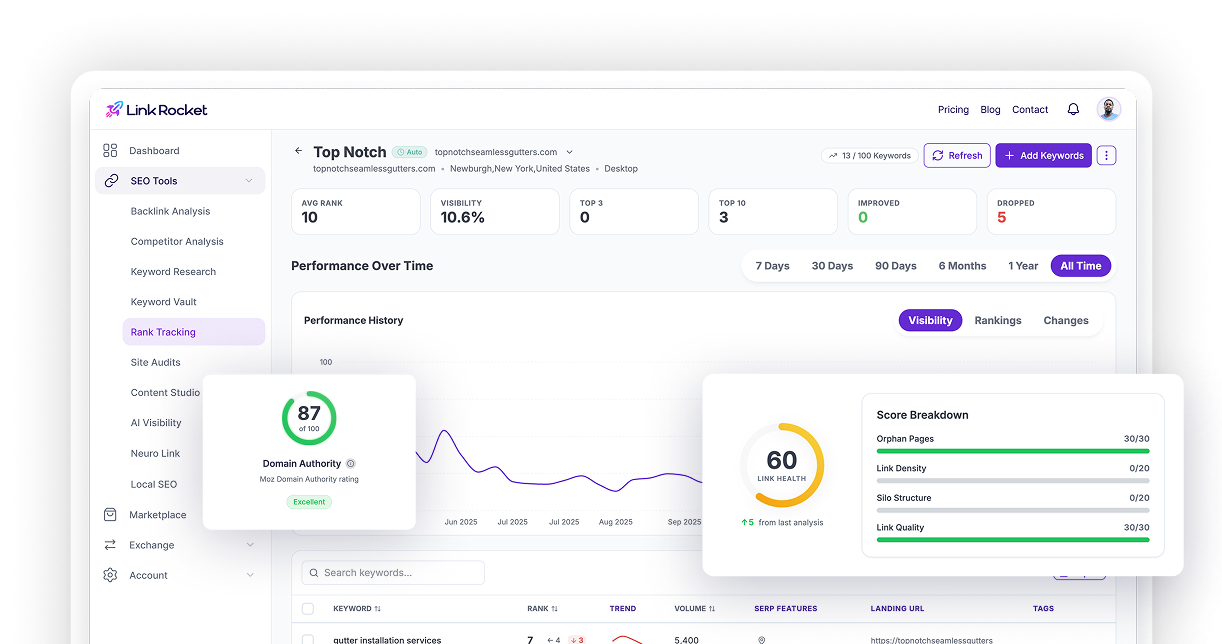
LinkRocket can help with each step: Site Audit for crawl and indexing problems, Keyword Research for intent and SERP features, Competitor Analysis for the links your rivals have and Rank Tracking to see what moves.
Do ranking factors apply to AI search?
Largely, yes. Google's AI Overviews and AI Mode draw on the same index and quality systems as regular results, and other AI assistants favor many of the same things: relevant, clear, trustworthy pages from recognized sources. Our AI Overviews guide and guide to getting cited by AI cover the differences.
The short version
Google ranks pages by working out what a search means, finding relevant pages and favoring the most helpful, reliable and usable ones for that searcher's context. In practice: be indexable, match intent, be genuinely the best answer, earn links and reputation, and keep pages fast and current. Ignore the 200-factor lists and the myths that come with them.
Frequently asked questions
What are the most important Google ranking factors?
Relevance to the search, helpful and reliable content, links and reputation, being crawlable and indexable, and a good page experience. How much each matters depends on the search.
How many ranking factors does Google use?
Google hasn’t published a number. It uses many signals across a set of ranking systems, and lists of “200 factors” are guesses rather than official.
Are backlinks still a ranking factor?
Yes. Google lists link analysis systems, including PageRank, among its ranking systems. Quality and relevance matter far more than quantity.
Is page speed a ranking factor?
It’s part of page experience, which Google uses, but it doesn’t outweigh relevance and quality. It matters most when competing pages are otherwise similar.
Does word count affect rankings?
No. Google has said word count isn’t a ranking factor. Write as much as the question needs.
Is E-E-A-T a ranking factor?
Not directly, but Google uses signals that line up with experience, expertise, authoritativeness and trust, especially for health, money and safety topics.
See what’s holding your rankings back
Crawl your site for indexing, speed and on-page issues. The Free plan includes a 50-page audit.