How to Run Your Entire SEO Workflow With AI (Without Losing the Plot)
It’s Monday morning and you have eleven client sites, a content calendar that’s three weeks behind, and a competitor who somehow published forty pages while you were still building a keyword list in a spreadsheet. You could grind through it the way you did in 2019. Or you could let software do the parts that never needed a human in the first place.
That second option is what most working SEOs have quietly moved to. Not because AI is magic, but because a modern SEO workflow has maybe five stages, and roughly three and a half of them are pattern-matching and data-shuffling that a machine does faster and more consistently than you ever will at 4pm on a Friday. The trick is knowing which half-stage still needs your brain.
The five stages, and who should actually do them
Every SEO project, stripped down, is the same loop: research what to target, audit what you’ve got, produce the content, earn the links, and track whether any of it worked. AI can take a first pass at all five. It should own maybe three of them outright. The other two it should assist with while you keep your hand on the wheel.
Here’s the honest split before we walk through each stage.
| Stage | Automate or assist? | Why |
|---|---|---|
| Keyword & competitor research | Automate the gathering, judge the picks | Pulling volume, difficulty, and gaps is mechanical. Deciding what to actually chase is strategy. |
| Technical & content audits | Automate almost fully | Crawlers and semantic scoring find issues far faster and more thoroughly than manual review. |
| Content production | Assist heavily, edit hard | AI gets you 70% of a draft in minutes. The last 30%, the part that ranks and reads like a person, is yours. |
| Link building | Automate discovery, own the relationships | Finding prospects scales. Outreach and judgment about quality do not. |
| Rank & visibility tracking | Automate entirely | Nobody should be manually checking positions. This is pure monitoring. |
Stage one: research, where the machine gathers and you decide
Keyword research is the stage people most want to fully automate and most shouldn’t. The gathering part, absolutely. Feed a seed term into Keyword Research and you get volume, difficulty, and SERP data back in seconds instead of an afternoon of tab-juggling. Point it at competitors and the gap analysis surfaces the terms they rank for and you don’t, which is usually where the fastest wins hide.
What the tool can’t do is know your business. It doesn’t know that a 200-volume keyword converts three times better for you than a 5,000-volume one because it maps to a service you actually sell. So let the software hand you the list, then you cut it. Park the survivors in Keyword Vault and organize them into collections by intent or campaign so the good ideas don’t evaporate the moment you close the tab. This is the pattern for the whole workflow in miniature: machine gathers, human chooses.
Stage two: audit, the part you can hand over almost completely
If there’s one stage where I’d tell you to trust the automation, it’s this one. A Site Audit crawls your pages and flags the technical problems, broken canonicals, thin or duplicate pages, crawl waste, the boring structural stuff that quietly caps your rankings, more thoroughly than any human doing a manual pass. You are not better than a crawler at this. Nobody is. Run it, read the priority list, fix from the top down.
The content side of auditing has gotten genuinely clever. The Content Audit inside Content Studio scores your existing pages against what’s actually ranking on page one for their target keyword. It doesn’t just say “add words.” It does entity and topic gap detection, showing which concepts your competitors cover that you skipped, and it labels each page Aligned, Drifting, or Irrelevant so you know whether a page needs a tweak or a teardown. That classification alone will save you from pouring hours into a page that was never going to rank for the term you had in mind.
The most valuable thing AI does in an audit isn’t finding problems. It’s ranking them, so you fix the one that moves the needle instead of the one that’s easiest.
Stage three: content, where automation earns its bad reputation
This is where people go wrong, so let me be blunt. AI content generation is a fantastic accelerator and a terrible autopilot. The workflow that works looks like this: generate a Content Brief, either from a target keyword or straight from your Keyword Research results, and shape it, article type, word count, tone, a custom outline you can reorder. Then generate the draft. In Content Studio that draft comes back structured and publication-shaped, and you refine it inline with rewrite, expand, and shorten tools on any passage you select.
Then you actually work. You add the specific example the model couldn’t invent, the opinion it won’t hold, the number from your own account, the sentence that sounds like you and not like every other AI-assisted page competing for the same query. The AI Citation Insertion feature can pull in relevant external references while you edit, which helps, but it doesn’t replace the human read-through. Revision History means you can experiment without fear because every version is saved. Publish straight to WordPress when it’s ready.
The people producing thin, ranking-nowhere content aren’t losing because they used AI. They’re losing because they shipped the first draft. The machine gets you to a strong starting point faster than ever. It does not get you to the finish line. If you remember one thing from this whole piece, make it that.
Stage four: links, discovery scales, relationships don’t
Link building is the stage where the automation-versus-judgment line is sharpest. Finding opportunities scales beautifully. Deciding whether an opportunity is worth pursuing, and doing the actual human outreach, does not.
On the discovery side, the Publisher Marketplace surfaces guest posting and placement opportunities so you’re not cold-Googling “write for us” pages for an hour. The Backlink Exchange runs on a credit model: you earn credits by placing links to other members’ sites, then spend those credits on placements pointing back to your own. It’s a structured way to build links without the usual manual prospecting slog. And Competitor Analysis with backlink gap detection tells you exactly which domains link to your rivals but not to you, which is the single best outreach list you can hand yourself.
What you don’t automate is the part where you look at a prospect and ask whether a link from it would actually help or just add noise to your profile. A tool can tell you a domain’s authority metrics. It can’t tell you the site is a link farm dressed up with a decent Domain Rating. That call stays yours, and it’s worth making carefully, because bad links are harder to undo than they are to avoid.
Stage five: tracking, the pure-monitoring stage nobody should touch by hand
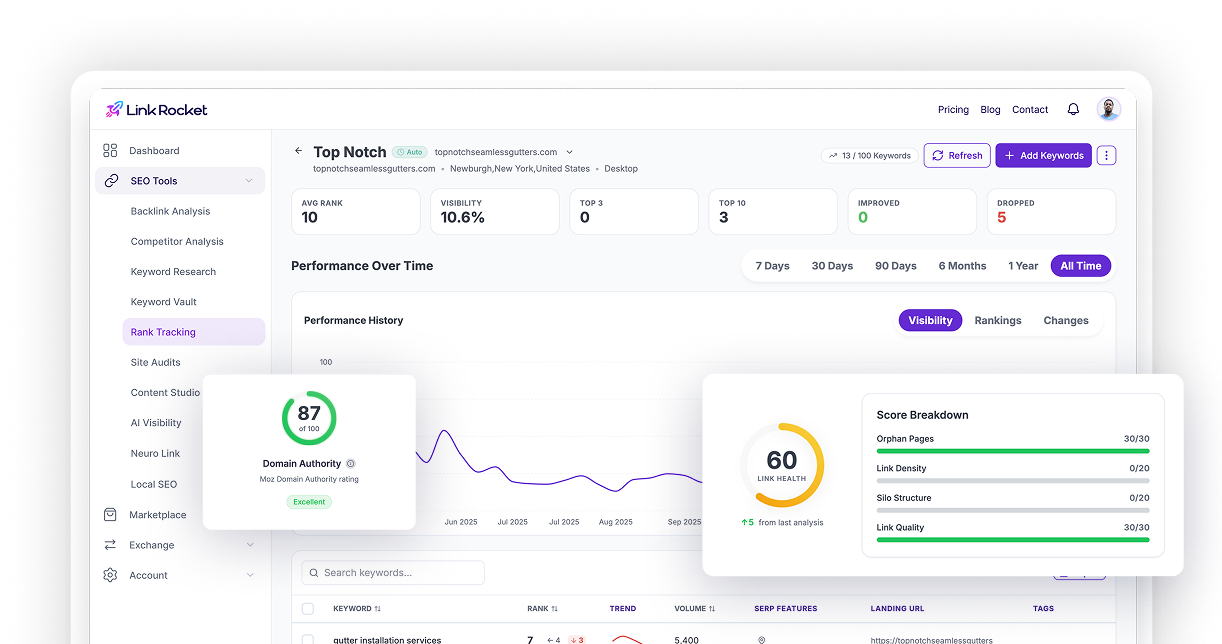
Here’s a stage to hand over without a second thought. Rank Tracking monitors your keyword positions over time so you’re not manually searching in an incognito window and lying to yourself about what you saw. It’s a Pro-tier and up feature rather than something on the free plan, which is fair, this is the kind of continuous monitoring that runs in the background and quietly tells you whether the last three stages actually worked.
There’s a newer layer of tracking that’s becoming non-optional. AI Visibility watches whether your brand shows up when people ask ChatGPT, Perplexity, Google AI Overviews, and Claude, not just where you sit in the classic blue links. A growing share of research and problem-solving now happens inside those assistants, and if you’re invisible there, you’re invisible to a chunk of demand that never touches a traditional results page. Track it the same way you track rankings, because it’s rapidly becoming the same thing.
Stitching the loop together
One connective piece worth naming: internal links. Once you’re producing content at AI speed, your own site structure becomes the thing you neglect. NeuroLink handles internal linking optimization so the pages you’re publishing actually pass authority to each other instead of sitting in isolation. It’s the kind of tedious-but-important housekeeping that’s perfect for automation, you’d never do it consistently by hand across a hundred pages, and the machine will.
What actually changes when AI runs the workflow
The real shift isn’t that you produce more, though you will. It’s where your hours go. Pull the gathering, the crawling, the scoring, the position-checking off your plate, and the time that’s left lands on the parts that were always the actual job: deciding what to target, judging what’s good, holding a point of view, and building the relationships that earn links no tool can manufacture. That’s a better use of a working SEO than formatting keyword spreadsheets, and it always was.
So automate the three-and-a-half stages that never needed you. Stay hands-on with the content edit and the link judgment. Treat the tools as the fastest junior researcher you’ve ever had, tireless, thorough, and completely without taste, and supply the taste yourself. Do that and you’re not competing with the people using AI. You’re competing with the ones who use it well, which is a much smaller crowd.
Frequently asked questions
Can AI really run an entire SEO workflow on its own?
Not entirely, and you shouldn’t want it to. AI can fully handle the mechanical stages like site audits and rank tracking, and it can take a strong first pass at research, content, and link discovery. But choosing which keywords to chase, editing content so it reads like a person, and judging whether a link is worth pursuing still need human judgment. Automate the grind, keep the decisions.
Which SEO tasks are safest to fully automate?
Technical audits and rank tracking are the safest. A crawler finds technical issues more thoroughly than any manual review, and position monitoring is pure background work nobody should do by hand. Internal linking optimization is another strong candidate, since it’s tedious and easy to neglect at scale.
Is AI-generated content bad for SEO?
AI content is only bad when you ship the first draft. Used as a starting point, it gets you most of the way to a solid article in minutes. The pages that rank are the ones where a human added specific examples, a real point of view, and details the model couldn’t know, then edited hard. The tool accelerates the draft; it doesn’t finish it.
Where does LinkRocket fit in an AI SEO workflow?
LinkRocket covers each stage of the loop: Keyword Research and Keyword Vault for research, Site Audit and Content Studio’s audit for diagnostics, Content Studio for production, Publisher Marketplace and Backlink Exchange for links, and Rank Tracking plus AI Visibility for monitoring. It’s built around the same automate-the-grind, keep-the-judgment split described here.
Does tracking AI search visibility actually matter yet?
Increasingly, yes. A growing share of research and problem-solving now happens inside assistants like ChatGPT, Perplexity, Google AI Overviews, and Claude. If your brand doesn’t surface there, you’re missing demand that never reaches a traditional results page. AI Visibility tracks exactly that, alongside your classic rankings.
Put the workflow to work
The fastest way to feel the difference is to start where the payoff is most obvious. Run a Site Audit to see what’s silently capping your rankings, then let Content Studio turn the gaps into briefs and drafts you can actually finish. Let the software do the gathering. You bring the judgment.